
Abnormal and oversized loads
Wide, long and awkward loads on low loaders and step frames, wrapped so the cover cannot lift or tear at speed and does not obscure lights or markings.
Talk to us
Transportation
Custom-fitted covers for abnormal loads, vehicles, machinery and freight. Sealed tight before the wheels turn, so what arrives is in the condition it left in.
The basics
Transport shrink wrap is a fitted polythene cover built around a load and heat-shrunk tight before it moves. It is variously called load covers, abnormal load wrapping, vehicle transport covers or freight wrapping, and it does a job a tarpaulin cannot: it stays sealed at motorway speed.
Most transit damage is not impact damage. It is the accumulation of road grime, salt spray, grit and rain over a few hundred miles, and it lands hardest on the things that cost most to put right — paintwork, gelcoat, machined faces and polished brightwork.
Some people search for it as load covers, abnormal load wrapping, vehicle transport covers or freight wrapping. It is the same process, and it is what we do every week.
The comparison
Applications
Wide, long and awkward loads on low loaders and step frames, wrapped so the cover cannot lift or tear at speed and does not obscure lights or markings.
Cars, supercars, classics and commercial vehicles sealed against stone chip, salt and road film for open transporter movements and long deliveries.
Excavators, generators, process equipment and fabricated assemblies protected between yard, port and site.
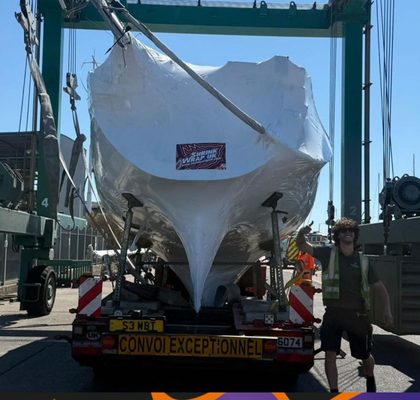
Hulls and marine equipment prepared for road movement, including craning, ferry crossings and European deliveries. See our marine service for full detail.
Bulk goods and palletised stock sealed for weather and tamper resistance on open trailers and in yards.
Assets wrapped for containerised and open-deck export where they may stand in port before onward movement.
Named projects
Anyone can say they wrap things. These are real sites, photographed as we left them. See every project →
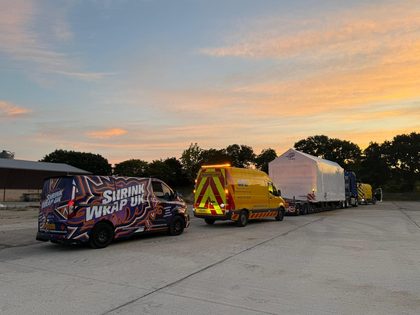
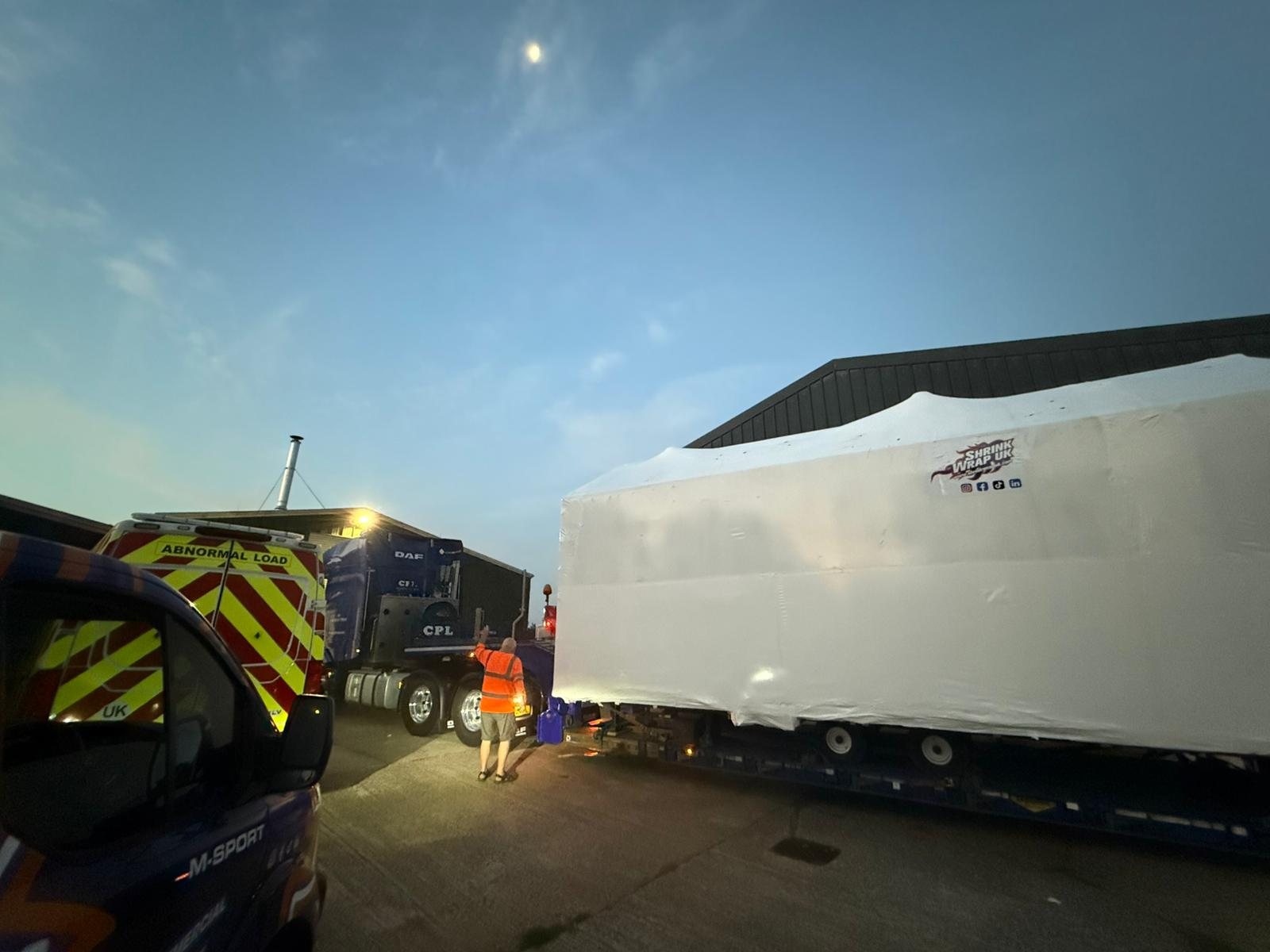
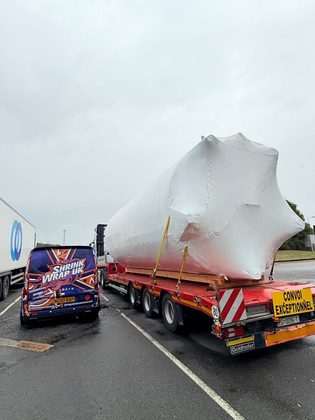
A large unit shrink wrapped on its low loader and moved at first light under abnormal-load escort, with our van in the convoy.
A cover that has to survive a motorway run cannot have a loose edge anywhere. Shrunk tight and detailed at every edge, it arrives the way it left.
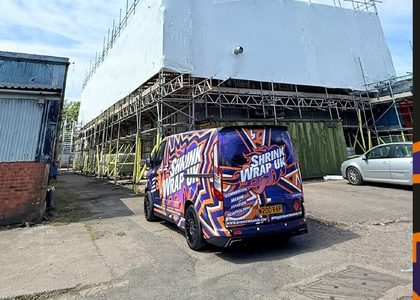
The elevation above Ronnie Scott’s on Frith Street, encapsulated while the club kept its doors open every night, alongside Pinnacle Scaffolding.
A venue that opens at 6.30pm and closes at 3am does not stop for a scaffold. The wrap sat above the fascia, the scaffold bridged the pavement, and the sign stayed lit underneath.
Shrink wrap enclosing the base of an Imperial College London building, running along the elevation and in under the entrance canopy behind Imperial’s own branded hoarding.
A university building stays open while work goes on. The wrap had to seal the work zone and sit cleanly alongside the client’s hoarding, in full view of everyone walking in.
The method
We agree with you and the haulier whether we wrap before loading or once the load is on the trailer, and where the lashing points and lifting eyes need to stay clear.
Sharp corners and high points are padded and battened so the film has a shape to shrink onto and nothing can punch through in transit.
Film is drawn over the load and heat-welded into one continuous skin, wrapped under the load line where the trailer allows.
Even heat passes bring the cover drum tight, and the film is banded and secured to the load bed so nothing can lift at speed.
Lights, markings, number plates, lashing points and any abnormal load signage are worked around, never covered.
Finished load is photographed for your records and the haulier, so condition on despatch is documented before it leaves.
Specification
Pricing
Area of film follows the profile. Awkward, tall and irregular loads need more battening as well as more film.
Wrapping at your depot during working hours is the cheapest option. Port-side and roadside work costs more.
Same-day and out-of-hours turnarounds before a sailing or a booked slot carry a premium.
A run to Birmingham and an open-deck crossing to Rotterdam call for different film and different securing.
Most transport jobs are quoted from photographs and dimensions within a couple of hours, because the deadline is usually a sailing or a booked slot rather than next month. Send the dimensions, the destination and the date it has to leave, and we will tell you what it costs and whether we can hit it.
Before we quote
Every job starts with a survey. We measure it, work out the frame, the film area, the seams and the fixings — and the number you get back is the number you pay. No provisional sums, no "subject to access".
Job 4463 · Portsmouth
Illustrative figures. Your survey is carried out on site — or from photos, if you'd rather start there.
Recent work
Where we work
We install transportation shrink wrap from our Isle of Wight base and travel the length of the country every week. Cowes, Southampton, Portsmouth, Port Solent, Poole, Bournemouth, Weymouth, Plymouth, Brighton, Chichester and Southend on the south coast; London, Croydon, Watford, Luton, Southend and Chatham in the south east; and Birmingham, Liverpool, Hull, Edinburgh, Glasgow and Aberdeen further north. Travel is priced into the quote up front, so there are no surprises.
Common questions
It depends on the size and shape of the load, where we wrap it, how quickly you need it and whether the journey is domestic or an open-deck crossing. Most transport quotes go back within a couple of hours of receiving photos and dimensions.
Yes. Because the film is shrunk tight with no loose edges, there is nothing for airflow to get under. It is loose sheeting and tarpaulins that fail at speed.
That is one of the main reasons people use it. A sealed skin keeps salt spray, road film and grit off paintwork, gelcoat and machined surfaces for the whole journey.
Yes. Vehicles are wrapped over a padded frame so the film never sits against paint, and finished so it can be removed without contact damage at the other end.
Either. Depot during working hours is the most economical, but we regularly work port-side and roadside where the lift plan requires it.
Yes. We prepare loads for ferry crossings, European deliveries and containerised export, including assets that will stand in port before onward movement.
No. Lights, plates, markings and any abnormal load signage are worked around as standard, never covered.
Usually the receiving site — it peels off cleanly with no residue. If you would rather we attended, tell us and we will arrange it.
Other services
Start from your phone
Not every job needs a site visit to get going. Send a couple of photos and rough dimensions and one of our installers will tell you what's involved — including when shrink wrap isn't the right call.
Whole item in frame, plus one close-up of the access side.
WhatsApp or email, with the postcode and the date you need it by.
Approach, timescale and a price — usually the same working day.
Quick quote
Rough dimensions and a photo are enough to get a price moving. If it's urgent, ring — someone who's actually installed the stuff will pick up.
Quick quote
Tell us what
needs covering.