
Full building encapsulation
Complete weatherproof envelopes for refurbishment, restoration and new build. Contains dust, debris and overspray, and lets internal trades work regardless of the forecast.
Talk to us
Scaffolding & roofs
Full encapsulation and temporary roof systems that keep weather out, dust in and the programme moving. Welded into one skin and shrunk tight to the frame, so it does not flap, tear or need patching every fortnight.
The basics
Scaffold shrink wrap is a heavy polythene film hung in panels over a scaffold, heat-welded panel to panel and then shrunk drum tight onto the frame. You will also see it called scaffold wrap, wrapped scaffolding, scaffold encapsulation or simply scaffold sheeting. It replaces monarflex, debris netting and tarpaulin on jobs that need real weather protection or containment.
The difference that matters is the weld. Traditional sheeting is fixed in overlapping panels and every lap is a route in for wind and water. A wrapped scaffold has no laps — it is one continuous membrane under tension, so there is nothing for a gust to get under.
Some people search for it as scaffold wrap, wrapped scaffolding, scaffold encapsulation or scaffold sheeting. It is the same process, and it is what we do every week.
The comparison
Applications
Complete weatherproof envelopes for refurbishment, restoration and new build. Contains dust, debris and overspray, and lets internal trades work regardless of the forecast.
Shrink wrapped roofs over beam systems for re-roofing, structural repairs and fire damage reinstatement. Keeps the building dry while the roof is open.
Fire-retardant grade film specified for occupied buildings, hot works and sites where the fire strategy requires it. We confirm the grade in writing with the quote.
Careful containment for stonework, lime mortar and conservation projects where the structure needs to stay dry for months and the scaffold cannot be over-loaded.
Sealed envelopes for controlled demolition, soft strip and dusty trades where material must not leave the site boundary.
Quiet, sealed containment for live environments where flapping sheeting and wind noise are not acceptable.
Free-standing screens and boundary containment where you need to separate a working area from a live one, control dust and tidy up how the site reads from outside.
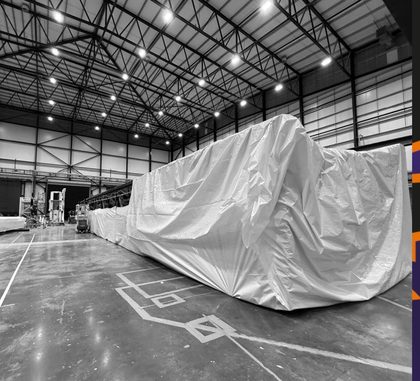
Modular and volumetric units wrapped for storage between projects and for road movement, sealed against weather ingress into open service voids.
Sealed internal partitions that let part of a unit be refurbished while the rest keeps trading, containing dust and holding heat on the working side.
Named projects
Anyone can say they wrap things. These are real sites, photographed as we left them. See every project →
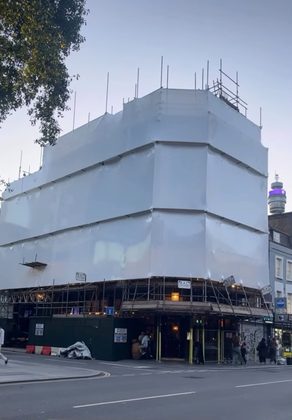
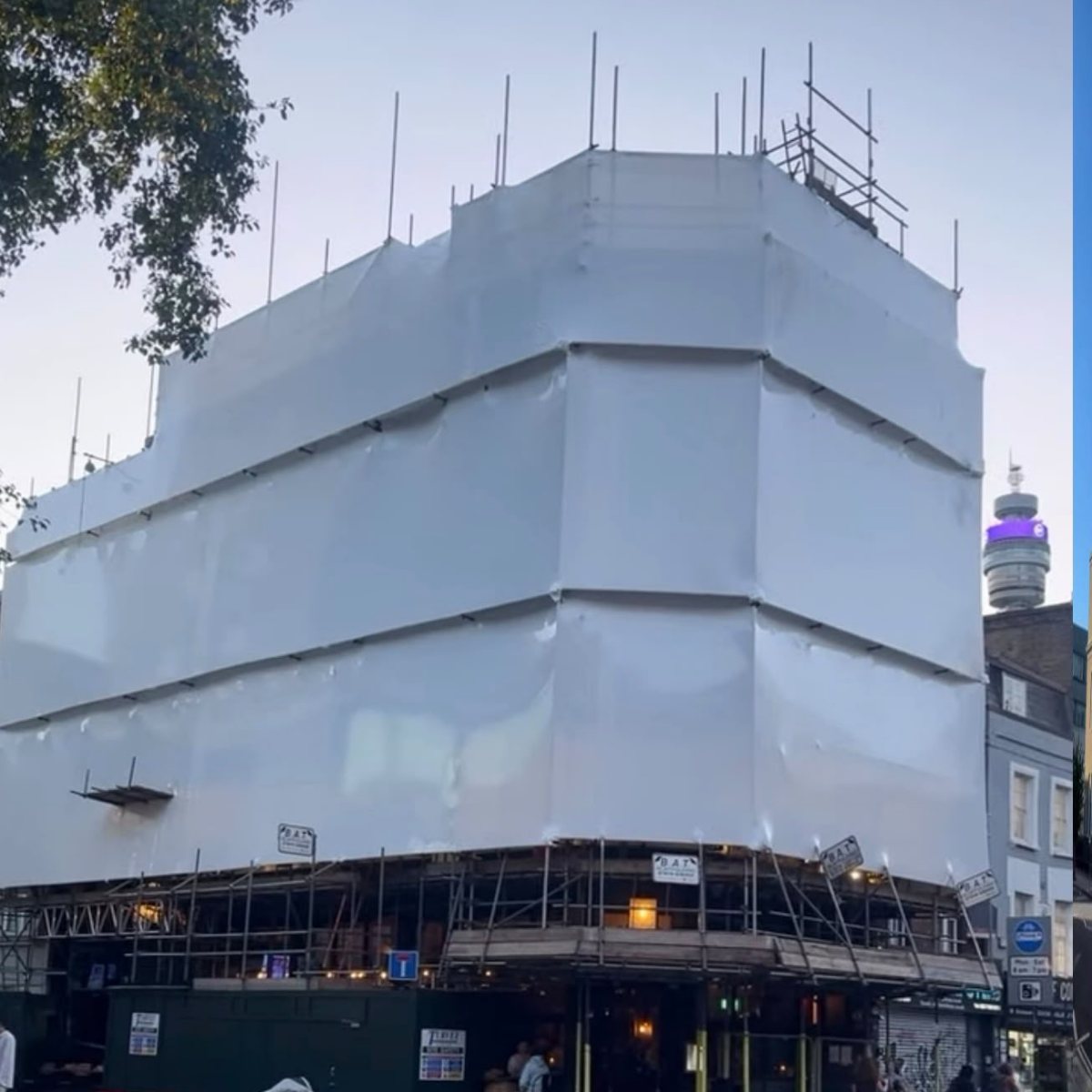
The elevation above Ronnie Scott’s on Frith Street, encapsulated while the club kept its doors open every night, alongside Pinnacle Scaffolding.
A venue that opens at 6.30pm and closes at 3am does not stop for a scaffold. The wrap sat above the fascia, the scaffold bridged the pavement, and the sign stayed lit underneath.
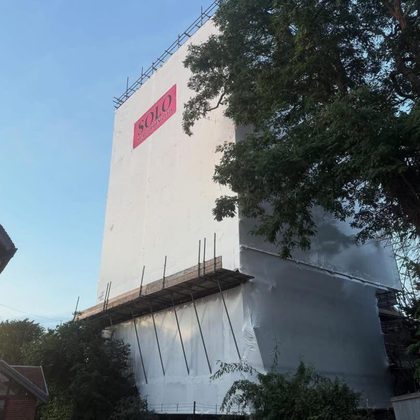
Shrink wrap enclosing the base of an Imperial College London building, running along the elevation and in under the entrance canopy behind Imperial’s own branded hoarding.
A university building stays open while work goes on. The wrap had to seal the work zone and sit cleanly alongside the client’s hoarding, in full view of everyone walking in.
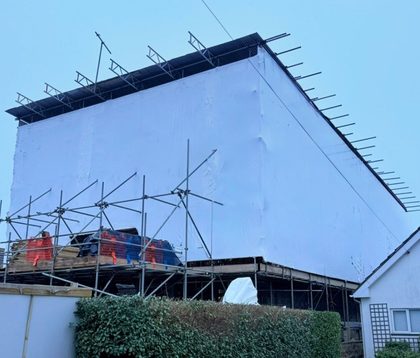
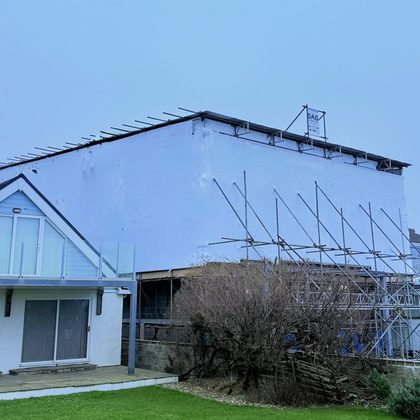
A scaffold-built temporary structure with a trussed roof, fully enclosed in shrink wrap alongside Stellar Scaffolding.
Photographed from bare frame to finished enclosure — the whole structure sealed, roof and elevations, and lit up at night.
The method
We work from the scaffold drawings, agree elevations, access and door positions, and issue risk assessments, method statements and hot works controls before we mobilise.
We confirm the structure is tagged, tied and designed for the additional wind loading a wrapped scaffold creates. If we think the design needs revisiting, we say so before we wrap.
Panels are pre-cut and labelled by bay and lift, allowing for returns, stair towers and tie positions. Less waste, faster install, fewer seams.
Panels are hung from the top lift and tacked to the ledgers, kept square to the standards with seam lines aligned before any heat goes near them.
Continuous welds along every overlap, doubled at corners, door perimeters and other high-load areas. Tie penetrations are patched behind.
Edges secured with batten and rope or mechanical fixings, base skirt sealed to shed water away from decks and pavements, zipped doors and vents fitted.
Even heat passes for a uniform finish, creases chased to the perimeter, tension checked around every door, corner and the base.
Photographs of the finished elevations, film certification and batch records, and guidance for your team on inspection through the programme.
Specification
Pricing
Pricing follows the square metres of film on the frame — every elevation, return, roof and stair tower.
Work from the scaffold itself is straightforward. Restricted access, live pavements and night working add crew time.
Flame-retardant and heavier gauges cost more per square metre. We specify to your requirement rather than defaulting up or down.
A cover that has to stand twelve months is specified differently from one covering an eight-week programme.
Anyone quoting a rate per square metre before seeing the drawings is guessing, and the guess gets corrected on your invoice. We take off from the scaffold drawings, survey the elevations and give you a fixed price with doors, vents and removal included. If the scaffold design will not carry a wrapped load, we tell you at that stage rather than after we have taken your order.
Before we quote
Every job starts with a survey. We measure it, work out the frame, the film area, the seams and the fixings — and the number you get back is the number you pay. No provisional sums, no "subject to access".
Job 4412 · Portsmouth
Illustrative figures. Your survey is carried out on site — or from photos, if you'd rather start there.
Recent work
Where we work
We install scaffolding shrink wrap from our Isle of Wight base and travel the length of the country every week. Cowes, Southampton, Portsmouth, Port Solent, Poole, Bournemouth, Weymouth, Plymouth, Brighton, Chichester and Southend on the south coast; London, Croydon, Watford, Luton, Southend and Chatham in the south east; and Birmingham, Liverpool, Hull, Edinburgh, Glasgow and Aberdeen further north. Travel is priced into the quote up front, so there are no surprises.
Common questions
It varies with film grade, access, lift height and how long the cover has to stand, so a headline rate is misleading. We take off from your scaffold drawings and give a fixed price with doors, vents and removal included, usually within 24 hours of the survey.
For weather protection and containment, yes. Sheeting is fixed in overlapping panels that flap, work loose and let water through at the laps. Shrink wrap is welded into one skin and shrunk tight, so it stays put, stays quiet and keeps the site dry. Netting still has its place where you only need debris containment and airflow.
Flame-retardant grades are available and are what we would normally specify for occupied buildings, hot works and most commercial scaffolding. Tell us your site requirements and we confirm the grade in writing with the quote and supply certificates at handover.
Flame-retardant film certified to EN 13501 and LPS 1207 is available and is what we specify wherever the fire strategy, an occupied building or nearby hot works require it. We state the grade on the quotation and supply the film certification and batch records at handover, so you have the evidence rather than an assurance. If your principal contractor or insurer has named a standard, tell us at enquiry stage and we will confirm it in writing before we start.
It can, and it matters. A wrapped scaffold catches considerably more wind than an open one, so ties, bracing and the design itself must account for it. We check the structure is tagged and designed for a wrapped load before we start, and flag it if it is not.
Several months to well over a year depending on exposure, film gauge and how the scaffold is set out. We specify the gauge for the length of your programme rather than defaulting to the cheapest option.
Yes, that is most of what we do. We survey the elevations, confirm the structure is suitable and wrap around the existing frame.
Yes. Zipped access doors, material hatches, clear vision panels and vents are all designed in at survey stage rather than cut in afterwards.
Yes. Risk assessments and method statements are supplied as standard, and handover includes photographs of the finished elevations plus film certification and batch records.
Other services
Start from your phone
Not every job needs a site visit to get going. Send a couple of photos and rough dimensions and one of our installers will tell you what's involved — including when shrink wrap isn't the right call.
Whole item in frame, plus one close-up of the access side.
WhatsApp or email, with the postcode and the date you need it by.
Approach, timescale and a price — usually the same working day.
Quick quote
Rough dimensions and a photo are enough to get a price moving. If it's urgent, ring — someone who's actually installed the stuff will pick up.
Quick quote
Tell us what
needs covering.