
In one paragraph
What is transport shrink wrap?
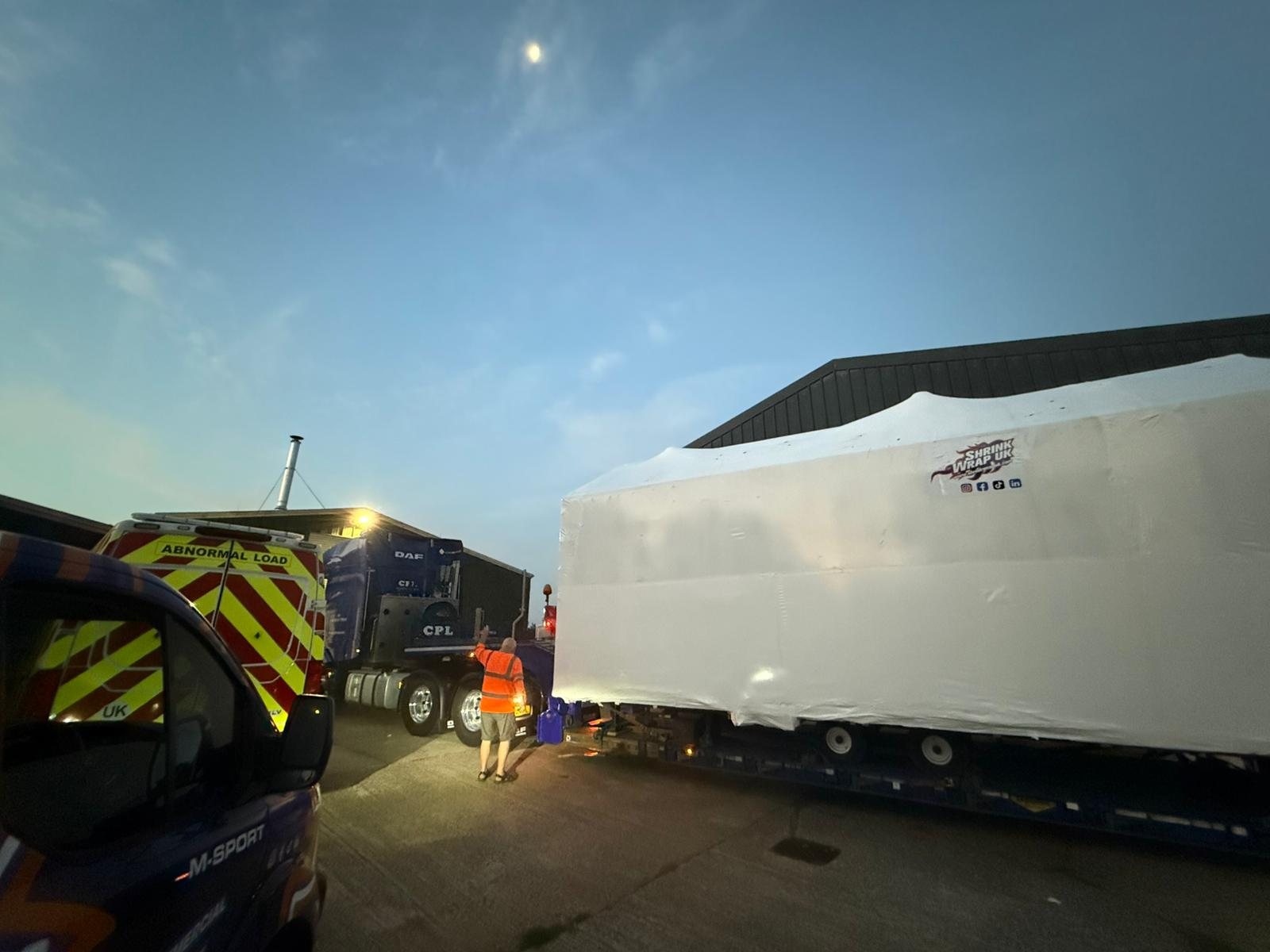
Transport shrink wrap is a fitted cover heat-shrunk tight around a load before it moves — a machine, vehicle, boat or abnormal load. With no loose edge for airflow to get under, it stays put at motorway speed and on an open deck, keeping out rain, salt spray, road grime and stone chip for the whole journey.
- Also called
- Load covers, abnormal load wrapping, freight wrapping
- Typical film
- 200–250 micron
- Main uses
- Road haulage, ferry, deck cargo, containers
- Key detail
- Lashing points and lifting eyes kept clear
- Main alternative
- Tarpaulins and sheeting
- After use
- Removed on arrival and recycled
The benefits of transport shrink wrap
Most of what makes it worth specifying comes down to one thing: it is a single sealed, tensioned skin rather than a set of loose panels. Everything below follows from that.
Does not lift at speed
No loose edges means nothing for the air to catch at motorway speed.
Seals out road grime
Rain, spray, salt and grit stay off the load for the whole run.
Tamper evident
A sealed cover shows immediately if anyone has been into the load.
Fits anything
Welded in situ around any shape — no standard sizes.
Lifting stays possible
Lashing and lifting points are left clear so the load can be craned and secured.
Nothing to return
No tarpaulins to recover from the far end.
When to use transport shrink wrap — and when not to
It is not the right answer for every job, and an installer who tells you otherwise is selling rather than advising.
Use it when
- A load is travelling any distance by road
- It is going on an open deck or ferry crossing
- It is being exported by container or sea freight
- It will stand outdoors before or after the move
Skip it when
- The load is enclosed in a box van or curtain-sider for a short local move
- It already has a fitted transport cover in good condition
How transport shrink wrap is installed, step by step
This is the part that separates a cover that lasts from one that fails in its first storm. Each step exists for a reason, and the reason is given with it.
Survey the load and route
Dimensions, lifting and lashing points, and how it travels — road, ferry, deck or container.
Pad sharp edges
Anything that could puncture film at speed is padded.
Frame if needed
Loads with protrusions get a frame so the film does not flog against them.
Wrap and weld
Film is fitted and welded into one skin, leaving lifting and lashing points clear.
Shrink
Heated until tight, with no loose edges for airflow.
Seal openings
Every edge and penetration is detailed so nothing can peel back.
Check before it moves
A final walk-round before the load is secured.
Transport shrink wrap versus the alternatives
The honest comparison, including where the cheaper option is the right one.
| Shrink wrap | Tarpaulin | Curtain-sider | |
|---|---|---|---|
| Stays on at speed | Yes | Often not | Yes |
| Seals out grime | Yes | Partly | Partly |
| Fits odd shapes | Any shape | Poorly | Box only |
| Open deck and ferry | Yes | Risky | No |
| Tamper evidence | Yes | No | No |
| Return logistics | None | Recover the sheet | Vehicle-bound |
Transport shrink wrap specification
What a proper specification should cover. If a quote does not mention these, ask.
| Film gauge | 200–250 micron; heavier for long or exposed runs |
|---|---|
| Edges | Fully detailed so nothing can lift in airflow |
| Lifting and lashing | Points kept clear and reinforced |
| Padding | At every sharp edge and protrusion |
| Export | Suitable for containerised and sea freight |
How much does transport shrink wrap cost?
There is no honest rate per square metre, because film is the cheapest part of the job. These are the things that actually move the price.
A quote worth trusting is fixed after survey, with removal priced in from the start and travel shown as its own line. If it says “subject to access”, it is not a price.
Before you call an installer
Have these to hand and you will get a realistic figure on the first call rather than the third.
- Load dimensions and weight
- Where lifting and lashing points are
- How it is travelling, and how far
- Where the load will be when it is wrapped
- The collection date and time
Transport shrink wrap glossary
- Abnormal load
- A load that exceeds standard size or weight limits for road transport.
- Deck cargo
- Freight carried on the open deck of a ship.
- Low loader
- A trailer with a low deck for tall or heavy loads.
- Lashing points
- Fixings used to secure a load during transport.
Transport shrink wrap FAQs
Will shrink wrap blow off on the motorway?
No. It is shrunk tight with every edge detailed, so there is nothing loose for airflow to lift.
Can a wrapped load still be craned?
Yes. Lifting eyes and lashing points are left clear during installation.
Is shrink wrap suitable for sea freight?
Yes. It is widely used for deck cargo, ferry crossings and containerised export.
Can you wrap a load on the trailer?
Yes — at the yard, the quay or on the trailer, whichever suits the lift and collection plan.
Why Shrink Wrap UK
Specialist installers, not a film seller
We do not sell film by the roll or run training courses. We install. Every word in this guide comes from doing the job, and if shrink wrap is the wrong answer for yours, we will tell you.
- Fixed price after survey
- Removal and disposal priced in
- RAMS supplied as standard
- Film certification at handover
- Isle of Wight base, crews UK-wide
- Same working day response