
Airframe storage
Fixed-wing aircraft protected for medium and long-term parking, indoors or on hardstanding, with vented envelopes and detailed protrusion sealing.
Talk to us
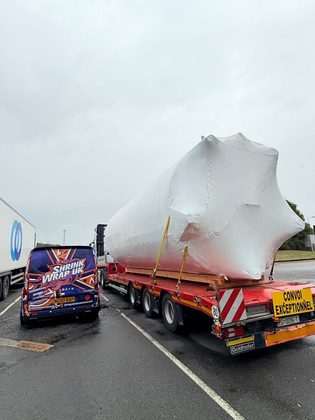
Aviation
Airframe and component protection for storage, maintenance and ferry preparation. Applied to aviation tolerances, with no contact loading on control surfaces, probes or antennae.
The basics
Aviation shrink wrap is a vented polythene envelope carried on a frame around an airframe, engine or component and heat-shrunk into one sealed skin. It goes by aircraft covers, airframe storage wrapping, aircraft preservation and MRO containment depending on the operator, and it is used for parking, maintenance, ferry preparation and export.
Aircraft do not tolerate the shortcuts that work elsewhere. Film cannot bear on control surfaces, pitot probes, static ports or antennae. Moisture cannot be sealed inside a fuselage. Anything applied has to come off without residue on paint or composite, and without anyone climbing on the structure to fit it.
Some people search for it as aircraft covers, airframe storage wrapping, aircraft preservation or MRO containment. It is the same process, and it is what we do every week.
The comparison
Applications
Fixed-wing aircraft protected for medium and long-term parking, indoors or on hardstanding, with vented envelopes and detailed protrusion sealing.
Helicopters wrapped for storage and movement, with rotor head, blades and tail boom treated as separate zones rather than one envelope.
Sealed containment around work areas in the hangar for paint, blast and composite work, keeping contamination away from adjacent aircraft.
Powerplants, nacelles and thrust reversers wrapped for storage, transport and pooling, with desiccant where the asset is standing long-term.
Wings, control surfaces, undercarriage assemblies and rotables protected for storage and onward shipment.
Airframes and components prepared for road and sea movement, including export and containerised shipment.
Named projects
Anyone can say they wrap things. These are real sites, photographed as we left them. See every project →
The elevation above Ronnie Scott’s on Frith Street, encapsulated while the club kept its doors open every night, alongside Pinnacle Scaffolding.
A venue that opens at 6.30pm and closes at 3am does not stop for a scaffold. The wrap sat above the fascia, the scaffold bridged the pavement, and the sign stayed lit underneath.
Shrink wrap enclosing the base of an Imperial College London building, running along the elevation and in under the entrance canopy behind Imperial’s own branded hoarding.
A university building stays open while work goes on. The wrap had to seal the work zone and sit cleanly alongside the client’s hoarding, in full view of everyone walking in.
A scaffold-built temporary structure with a trussed roof, fully enclosed in shrink wrap alongside Stellar Scaffolding.
Photographed from bare frame to finished enclosure — the whole structure sealed, roof and elevations, and lit up at night.
The method
We walk the aircraft with your engineering team and agree the method statement, the zones and every protrusion that needs individual treatment before anything is brought into the hangar.
A freestanding, non-contact cradle is built around the airframe so the film is carried entirely on the frame. Nothing bears on control surfaces, panels or composite.
Fuselage, wings, empennage and, on rotorcraft, the rotor head and tail boom are treated as separate zones rather than one envelope. It gives a better result and far easier access.
Pitot probes, static ports, aerials, drains and vents are each detailed and sealed individually, never bridged over.
Film is welded into a continuous skin and brought tight with controlled heat passes, kept clear of the airframe throughout.
Vents are placed for the envelope volume, desiccant added for long-term parking, and the finished cover is photographed zone by zone for your records.
Specification
Pricing
Envelope area and cradle complexity both scale with the aircraft, and rotorcraft are zoned differently from fixed wing.
The non-contact frame is a significant part of the job. Simple, flush airframes cost less to cradle than heavily instrumented ones.
Every probe, port and aerial is an individual detail, and heavily instrumented aircraft take longer.
Long-term parking needs more ventilation and desiccant, and periodic inspection can be built in.
Aviation is quoted job by job, because a light aircraft going into storage for a season and an instrumented airframe being preserved for two years are entirely different pieces of work. We will walk the aircraft with your engineering team, agree the method in writing, and price it once — including removal and any periodic inspection you want built in.
Before we quote
Every job starts with a survey. We measure it, work out the frame, the film area, the seams and the fixings — and the number you get back is the number you pay. No provisional sums, no "subject to access".
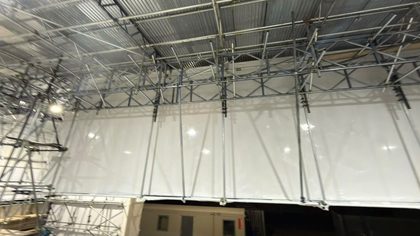
Job 4519 · Farnborough
Illustrative figures. Your survey is carried out on site — or from photos, if you'd rather start there.
Recent work
Where we work
We install aviation shrink wrap from our Isle of Wight base and travel the length of the country every week. Cowes, Southampton, Portsmouth, Port Solent, Poole, Bournemouth, Weymouth, Plymouth, Brighton, Chichester and Southend on the south coast; London, Croydon, Watford, Luton, Southend and Chatham in the south east; and Birmingham, Liverpool, Hull, Edinburgh, Glasgow and Aberdeen further north. Travel is priced into the quote up front, so there are no surprises.
Common questions
It is driven by airframe size, how complex the non-contact cradle has to be, how many protrusions need individual sealing and how long the aircraft is being stored. We survey with your engineering team and price the job once, including removal.
No. It is carried on a freestanding cradle so nothing bears on the airframe, and it is removed without leaving residue on paint or composite surfaces.
Each protrusion is detailed and sealed individually rather than bridged over, and every one is recorded on the handover sheet so nothing is missed on removal.
Yes, provided the envelope is vented and, for longer periods, desiccated. Sealing an airframe without managing moisture causes more problems than it solves, which is why vent placement is designed for each cover.
Flame-retardant grades certified to EN 13501 are available across our range and are standard on occupied premises and anywhere hot works are taking place nearby. Certification and batch records are supplied at handover.
Yes. Rotorcraft are treated as separate zones — rotor head, blades, tail boom and fuselage — rather than one envelope, which gives a better result and much easier access.
Yes. Our crews work to your hangar induction, permits and access windows, and we agree the method statement with your engineering team before we start.
Yes. We prepare airframes, engines, nacelles and components for road, sea and containerised movement, including export.
Flame-retardant grades are available and are what we would normally specify for hangar environments and anywhere hot works are taking place. Certificates are supplied with handover.
Other services
Start from your phone
Not every job needs a site visit to get going. Send a couple of photos and rough dimensions and one of our installers will tell you what's involved — including when shrink wrap isn't the right call.
Whole item in frame, plus one close-up of the access side.
WhatsApp or email, with the postcode and the date you need it by.
Approach, timescale and a price — usually the same working day.
Quick quote
Rough dimensions and a photo are enough to get a price moving. If it's urgent, ring — someone who's actually installed the stuff will pick up.
Quick quote
Tell us what
needs covering.