
In one paragraph
What is aircraft shrink wrapping?
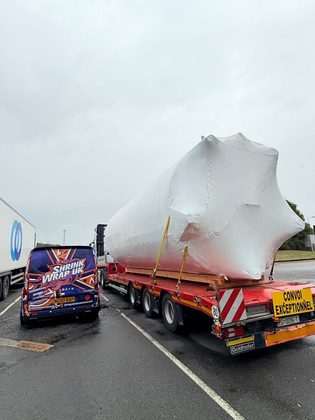
Aircraft shrink wrapping is a vented protective envelope carried on a freestanding cradle around an airframe, engine or component, so the film never bears on the aircraft itself. Every probe, port and aerial is sealed individually, and the whole envelope is ventilated so moisture cannot be trapped inside.
- Also called
- Aircraft covers, airframe storage wrapping, aircraft preservation
- Typical film
- 200 micron, on a non-contact cradle
- Main uses
- Storage, MRO containment, component transport
- Key rule
- Zero contact with control surfaces and probes
- Main alternative
- Fitted fabric covers
- After use
- Removed without residue and recycled
The benefits of aircraft shrink wrapping
Most of what makes it worth specifying comes down to one thing: it is a single sealed, tensioned skin rather than a set of loose panels. Everything below follows from that.
Nothing touches the aircraft
The film is carried entirely on a cradle, so control surfaces, probes and composite panels bear no load.
Every protrusion sealed
Pitot probes, static ports and aerials are detailed and recorded one by one.
Moisture managed
Vents and desiccant stop condensation inside the fuselage and envelope.
Zoned for access
Fuselage, wings and empennage can be separate zones, opened independently.
MRO containment
Paint, blast and composite work is kept away from adjacent aircraft in the hangar.
Clean removal
No residue on paint or composite, and nobody climbs on the structure.
When to use aircraft shrink wrapping — and when not to
It is not the right answer for every job, and an installer who tells you otherwise is selling rather than advising.
Use it when
- An aircraft is going into medium or long-term storage
- Engines, nacelles or components are being stored or shipped
- Paint, blast or composite work needs containing inside a hangar
- A heritage airframe is going into preservation
Skip it when
- The aircraft is flying regularly and only needs short-term covers
- An approved OEM cover exists and is specified for that type
How aircraft shrink wrapping is installed, step by step
This is the part that separates a cover that lasts from one that fails in its first storm. Each step exists for a reason, and the reason is given with it.
Agree the method
The method statement is agreed with the engineering team before anything enters the hangar.
Build the cradle
A freestanding frame is built around the airframe so the film is carried on it, not the aircraft.
Zone the envelope
Fuselage, wings and empennage — or rotor head, blades and tail boom — are treated as separate zones.
Seal protrusions
Each probe, port, aerial and drain is sealed individually and recorded.
Hang, weld and shrink
Film is welded into each zone and shrunk tight to the cradle.
Ventilate
Vents and desiccant are placed for the envelope volume and storage period.
Record and hand over
A record of every sealed protrusion, so nothing is missed on removal.
Aircraft shrink wrapping versus the alternatives
The honest comparison, including where the cheaper option is the right one.
| Shrink wrap on cradle | Fitted fabric covers | Open parking | |
|---|---|---|---|
| Contact with aircraft | None | Direct | None |
| Full enclosure | Yes | Partial | No |
| Moisture control | Vents and desiccant | Limited | None |
| UV and dust | Blocked | Partly | Exposed |
| MRO containment | Yes | No | No |
| Protrusion record | Yes | No | — |
Aircraft shrink wrapping specification
What a proper specification should cover. If a quote does not mention these, ask.
| Film gauge | 200 micron, carried on a non-contact cradle |
|---|---|
| Contact points | Zero on the airframe |
| Protrusions | Individually sealed and recorded |
| Moisture | Vents plus desiccant for anything beyond a few months |
| Zoning | Separate zones for fuselage, wings, empennage or rotors |
| Working | To hangar induction, permits and access windows |
How much does aircraft shrink wrapping cost?
There is no honest rate per square metre, because film is the cheapest part of the job. These are the things that actually move the price.
A quote worth trusting is fixed after survey, with removal priced in from the start and travel shown as its own line. If it says “subject to access”, it is not a price.
Before you call an installer
Have these to hand and you will get a realistic figure on the first call rather than the third.
- Aircraft or component type
- Storage duration, or transport route
- Hangar induction and permit requirements
- Engineering contact for the method statement
- Any inspection access needed during storage
Aircraft shrink wrapping glossary
- Cradle
- A freestanding frame that carries the film clear of the aircraft.
- Empennage
- The tail assembly of an aircraft.
- Pitot probe
- A sensor that measures airspeed — must not be damaged or blocked.
- MRO
- Maintenance, repair and overhaul.
- Nacelle
- The housing around an aircraft engine.
Aircraft shrink wrapping FAQs
Does shrink wrap touch the aircraft?
No. The film is carried on a freestanding cradle, so nothing bears on control surfaces, probes or composite panels.
How are probes and ports protected?
Each is sealed individually and recorded, so all of them are accounted for on removal.
Will moisture build up inside?
Not if the envelope is vented and dried properly. Vents and desiccant are sized for the volume and storage period.
Can you work inside a live hangar?
Yes, to the hangar induction, permits and access windows, with the method agreed with engineering first.
Why Shrink Wrap UK
Specialist installers, not a film seller
We do not sell film by the roll or run training courses. We install. Every word in this guide comes from doing the job, and if shrink wrap is the wrong answer for yours, we will tell you.
- Fixed price after survey
- Removal and disposal priced in
- RAMS supplied as standard
- Film certification at handover
- Isle of Wight base, crews UK-wide
- Same working day response